


Anomaly Federal’s crowdsourced intelligence (CROSINT) mobile application, “NSSE,” represents an innovative approach to enhancing public safety through the collection of aerial data contributed by the general public. The solution turns every person with a smartphone into an edge sensor to detect, identify and geolocate UAS, reporting data one direction to the command and control (C2) system of your choosing. Our mobile app can be replicated, white-labelled and tailored for usage for any type of event, big and small.
Computer Vision for Automated UAS Detection
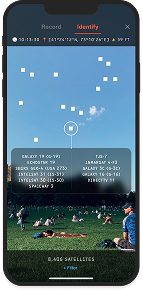
The CV pipeline harnesses semantic sky segmentation and automated labeling to curate training data, then trains edge-deployable detectors for rapid analysis. The pipeline also focuses on object behavior such as strobing and movement patterns, which feed into object identification and threat scoring.
* No network build required
* Airspace awareness without infrastructure burden

General Ross, JIATF-401
“What we need is a layered defence: awareness, different capabilities and an ecosystem that works together so we can defeat threats consistently.”
Optional Semantic Segmentation
Real-World Dataset
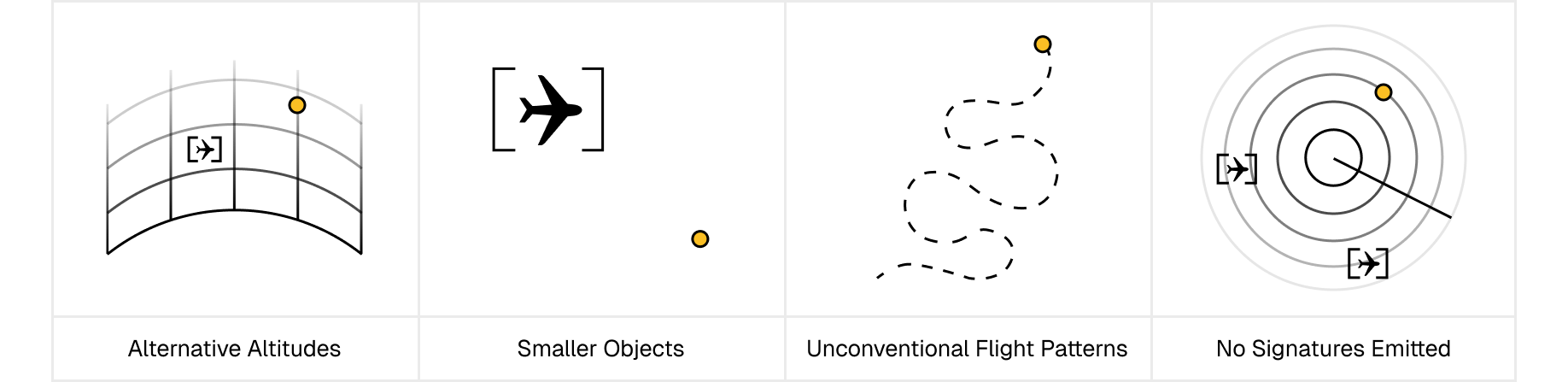
The U.S. combatant commands are facing next-gen aerial threats that encroach on restricted military airspace and critical infrastructure sites. There are sensor gaps in detecting objects that fly at low altitudes, have small cross-radar sections, unusual flight patterns, and don’t emit signatures. Anomaly Federal (AF) is laser focused on detecting these aerial objects, in both CONUS and OCONUS situations.
General Guillot, Commander Northcom
“Sensor gaps continue to exist when it comes to identifying small, low altitude objects”
Incursions by unified UAS in CONUS airspace
The U.S. combatant commands are facing next-gen aerial threats that encroach on restricted military airspace and critical infrastructure sites. There are sensor gaps in detecting objects that fly at low altitudes, have small cross-radar sections, unusual flight patterns, and don’t emit signatures. Anomaly Federal (AF) is laser focused on detecting these aerial objects, in both CONUS and OCONUS situations.


